
How AI Agents became the digital world’s first users reversing Humans and taking first place
AI Traffic is growing 6.5x faster than Human traffic. Here’s what it means for you

On June 3, 2026, Cloudflare CEO Matthew Prince posted something on X that stopped the tech world in its tracks.
“Welp, that happened faster than I predicted. Thought it would be end of 2027, then early 2027, but agentic traffic growing so fast that bots have now passed human traffic online for the first time in the Internet’s history.”
He expected this moment. He did not expect it 18 months early.
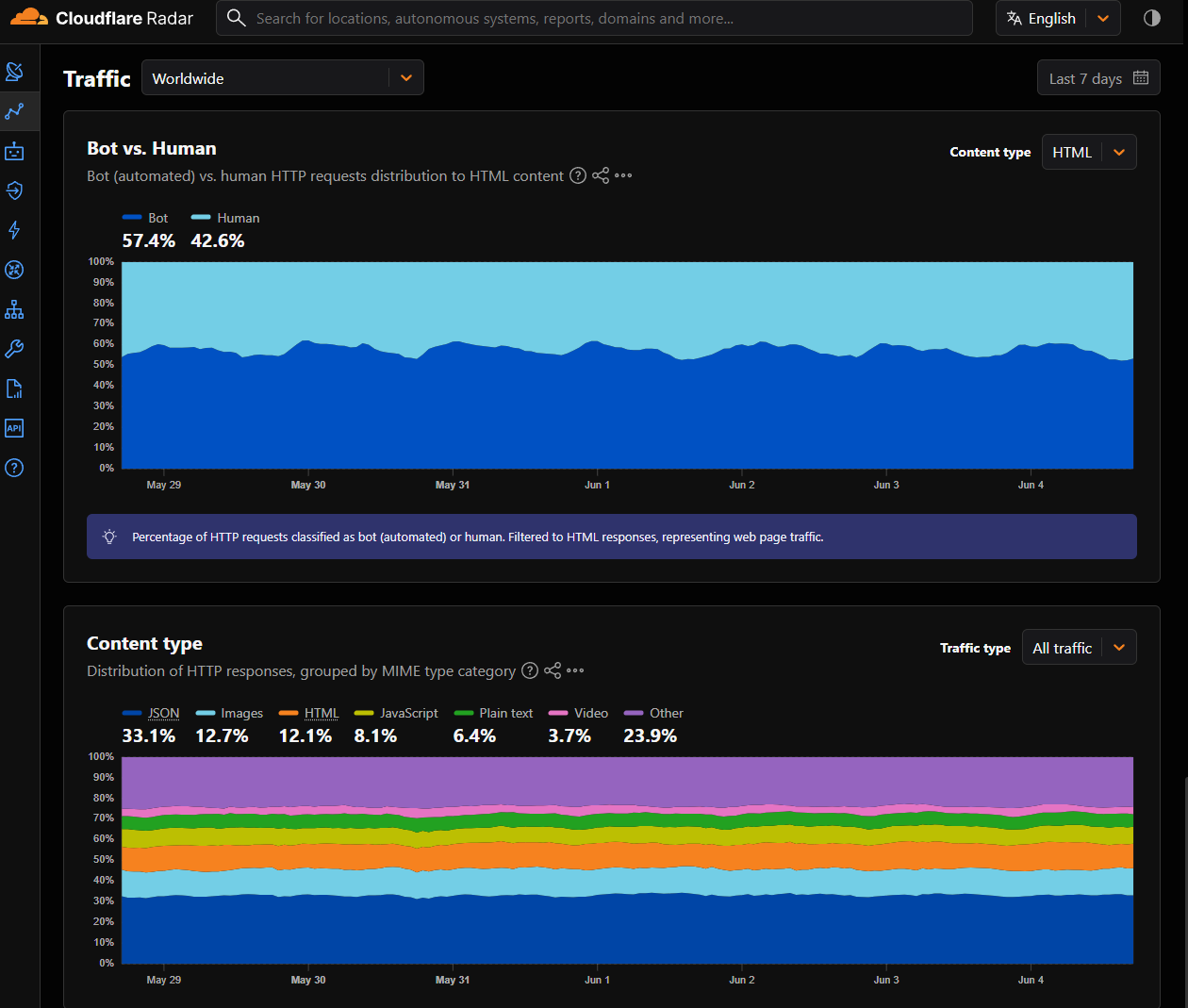
According to Cloudflare Radar a tool that tracks real-time internet traffic across roughly 20% of all global websites bots now account for 57.4% of all HTTP requests. Humans generate just 42.6%. For the first time since the invention of the World Wide Web, we are no longer the majority users of the internet we built.
This is not a story about spam. This is a story about a civilizational shift that is rewriting the rules of every digital business on earth.
For thirty years, humans were the first users of the internet.
Humans searched.
Humans clicked.
Humans scrolled.
Humans compared.
Humans bought.
Humans watched ads.
Humans filled forms.
Humans moved through websites, apps, dashboards, and checkout pages.
Every major digital company was built around this assumption.
Google optimized discovery for humans.
Meta optimized attention for humans.
Amazon optimized conversion for humans.
Netflix optimized retention for humans.
Stripe optimized checkout for humans.
Salesforce optimized enterprise workflows for humans.
Booking optimized travel decisions for humans.
The internet has a new majority
The old internet had one primary user: the human.
Humans created the demand.
Humans navigated the interface.
Humans made the decisions.
Humans completed the actions.
But AI agents change the shape of digital activity.
A human looking for a camera might visit five websites.
An AI agent doing the same task may visit five thousand.
A human planning a trip might compare ten hotels.
An AI travel agent can compare thousands of hotels, flights, reviews, cancellation policies, locations, loyalty programs, and prices in seconds.
A human procurement manager might contact three vendors.
An AI procurement agent can scan hundreds, compare terms, check compliance, summarize risks, and prepare a recommendation.
This is why AI traffic grows differently.
It does not grow like human traffic.
It compounds.
One human request can trigger hundreds or thousands of machine actions.
One prompt can become a network of queries, comparisons, validations, and executions.
The human remains the source of intent.
But the agent becomes the operator.
That is the new internet.
The Numbers Are Not Subtle
The data that preceded this moment should have been impossible to ignore. HUMAN Security, a cybersecurity firm that processed over one quadrillion digital interactions in 2025 alone, released its 2026 State of AI Traffic report in March with findings that left little room for ambiguity:
Automated traffic grew eight times faster than human traffic year-over-year in 2025.
AI-driven traffic volumes increased 187% from January to December 2025 nearly tripling in a single calendar year.
Traffic from AI agents and agentic browsers grew a staggering 7,851% year-over-year.
More than 95% of all AI-driven traffic concentrated in three sectors: retail and e-commerce, streaming and media, and travel and hospitality.
To put the 7,851% figure in context: human traffic grew 3.1% in the same period. AI agent traffic grew at a pace roughly 2,500 times faster.
The exact tipping point — the precise hour when machines became the dominant species on the internet remains uncertain. Cloudflare’s Prince admits the data is “a bit messy.” But as he wrote with characteristic bluntness: “We are clearly on the other side now.”
Before we go further, let’s be precise about what is happening. The machines driving this shift are not the bots of the old internet not spam crawlers filling your comment section, not price scrapers running on someone’s laptop. Those still exist and have grown too (fake account creation surged 259% between 2023 and 2024, and another 89% in 2025). But they are not what tipped the scales.
The dominant new force is something called agentic AI: autonomous systems that act on behalf of human users, navigating the web as a proxy but at a scale and speed no human could match.
If HUMAN Security and Cloudflare were not enough, Fastly one of the world’s largest edge cloud networks published its own data on June 9, 2026, and it only deepens the picture.
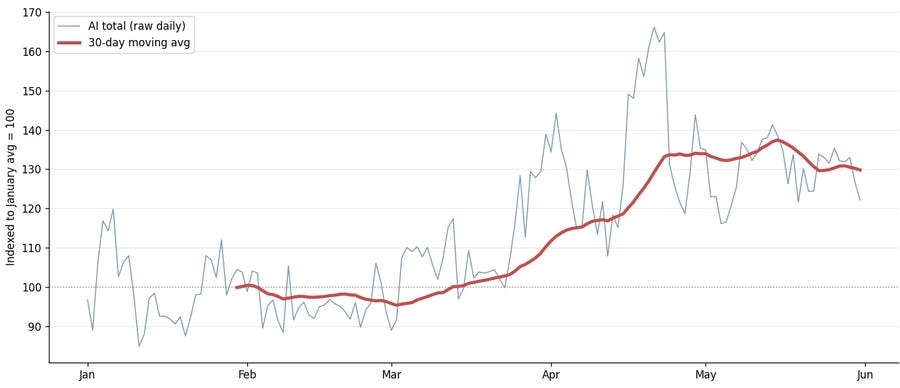
From January through May 2026, AI requests on Fastly’s platform grew approximately 30% in just five months — roughly 6.5x faster than human traffic in the same period. Autonomous machine-to-machine traffic is now approaching half of all internet requests on their network, encompassing crawlers, bots, agents, and API-driven systems.
But Fastly’s data adds something the other reports don’t: a crucial distinction between two fundamentally different types of AI traffic.
AI crawlers are the bulk, schedule-driven systems that sweep the open web continuously to assemble training data for large language models. They behave like traditional search-engine crawlers but never stop they do not sleep, pause for weekends, or wait until morning. Their activity is flat and consistent across all 24 hours of the day, every day.
AI fetchers are something else entirely. These are agents acting on behalf of users in real time pulling information to answer a question, compare options, check availability, summarize content, or execute a transaction. They are not on a schedule. Their volume tracks directly with AI assistant adoption. Every time a user prompts ChatGPT, Gemini, or Claude, a fetcher is dispatched. Fastly reports Claude traffic alone has grown more than 555% over its January 2026 baseline.
As of May 2026, Fastly’s network traffic was 85% crawlers and 15% fetchers but the fetcher share is the one accelerating fastest, because it is tied directly to user behavior and agent adoption. As more humans delegate more tasks to AI assistants, the fetcher layer explodes.
The infrastructure implications of this split are staggering. Fastly’s data shows that less than 9% of human requests require a trip back to origin servers most human traffic is served from cache. By contrast, more than 51% of AI requests require fresh data from origin infrastructure. AI agents are not satisfied with cached snapshots. They want live prices, current inventory, the latest article, real-time context. On a request-by-request basis, AI workloads hit origin infrastructure more than six times as often as human users.
At internet scale, this is not a configuration tweak. It is an architectural reckoning.
The Architecture of the Agentic Internet
To understand why this is more than a traffic curiosity, you need to understand what agents are actually doing out there.
The old model of internet interaction was linear and human-paced: you opened a browser, typed a query, clicked a link, read a page, made a decision. Companies built their entire digital stack around this interaction loop. Their SEO, their UX, their advertising, their conversion funnels all of it optimized for the ten-second attention span of a human moving their finger across a screen.
Agentic AI breaks every assumption in that stack simultaneously.
Agents don’t read web pages they parse them. They are not looking for compelling headlines or beautiful hero images. They are extracting structured data: prices, specs, availability, terms. A wall of beautiful brand copy is invisible to them.
Agents don’t browse, they execute. When an agent is tasked with booking the cheapest flight from Paris to Tokyo on a Friday in July, it doesn’t “browse.” It queries, compares, filters, and transacts. The journey from task to completion is measured in seconds, not sessions.
Agents don’t get bored, distracted, or emotionally swayed. They cannot be upsold by a flash sale banner. They cannot be retargeted after abandoning a cart. They do not respond to urgency tactics, scarcity cues, or loyalty program notifications.
And most critically: agents don’t click ads.
The Death of the Attention Economy
For thirty years, one business model ruled the internet with iron consistency: monetize human attention through advertising. Google built a trillion-dollar empire on it. Facebook built another. The entire media industry restructured itself around it. The logic was elegant humans look at things, things can be turned into eyeballs, eyeballs can be sold.
That logic is now under structural attack.
A research paper on the “Agentic Web” published in 2026 framed the crisis plainly: “The ad-supported model, which monetizes human attention, is breaking down as agents become the primary interface for information retrieval, disintermediating and reducing traffic to content websites.”
The publishing industry is already feeling the full force of this. Akamai found that 63% of all AI bot triggers target the publishing sector the industry least equipped financially to absorb traffic that generates zero corresponding ad revenue. When GPTBot scrapes a news article to answer a user’s question, the publisher receives a visit but not a reader. The page loads but no human sees it. No ad impression is served. No revenue is earned. The content is consumed but the economic loop is severed.
Meanwhile, traditional advertising models are breaking down in parallel. The pollution of behavioral data by synthetic agents is rendering targeted advertising increasingly unreliable. Klover.ai’s 2026 analysis was unsparing: the combination of AI agent activity and privacy protocols has made traditional targeted advertising “functionally obsolete.” Survival, they argued, requires treating AI agents as “primary, capitalized financial consumers rather than algorithmic obstacles to human eyeballs.”
Humans are becoming the tools
Here is where the narrative gets philosophically uncomfortable and where I want you to sit with an idea that most industry commentary is tiptoeing around.
We built the digital economy on one premise: humans are the consumers, and technology serves them.
That premise is inverting.
In the emerging architecture of the agentic internet, AI agents are the primary consumers of digital services. They are the ones making queries, processing content, comparing products, executing transactions. Humans are increasingly the initiators of intent, the ones who say “I want X”but the actual work of navigating the digital world is delegated upward to agents.
In this model, humans are becoming the input layer. The prompt. The goal-setter. The approver.
This is not science fiction. It is the logical extension of what we can already observe. When a user asks an AI assistant to manage their inbox, the assistant becomes the primary “user” of their email platform. When an agent manages your investment portfolio, it becomes the primary “user” of your brokerage. When an agent books your travel, handles your customer service, manages your subscriptions the platforms built for “you” are increasingly being operated by machines running on your behalf.
The MIT Platform Strategy Summit in 2025 captured this perfectly: “You are going to launch a marketplace, you’re going to have to onboard and get critical mass for agents.” Not users. Agents.
PwC’s 2026 business predictions noted that agents can now handle roughly half of the tasks that people currently do. A Salesforce study of CIOs found AI adoption had skyrocketed 282% year-over-year. The AI agent market, worth $7.84 billion in 2025, is projected to hit $52.62 billion by 2030 a 46.3% compound annual growth rate.
What companies must do: Design for the AI Agents majority
The companies that survive this transition will be the ones that accept a counterintuitive truth: your next great user experience may not be designed for humans at all.
This means rethinking several things at once.
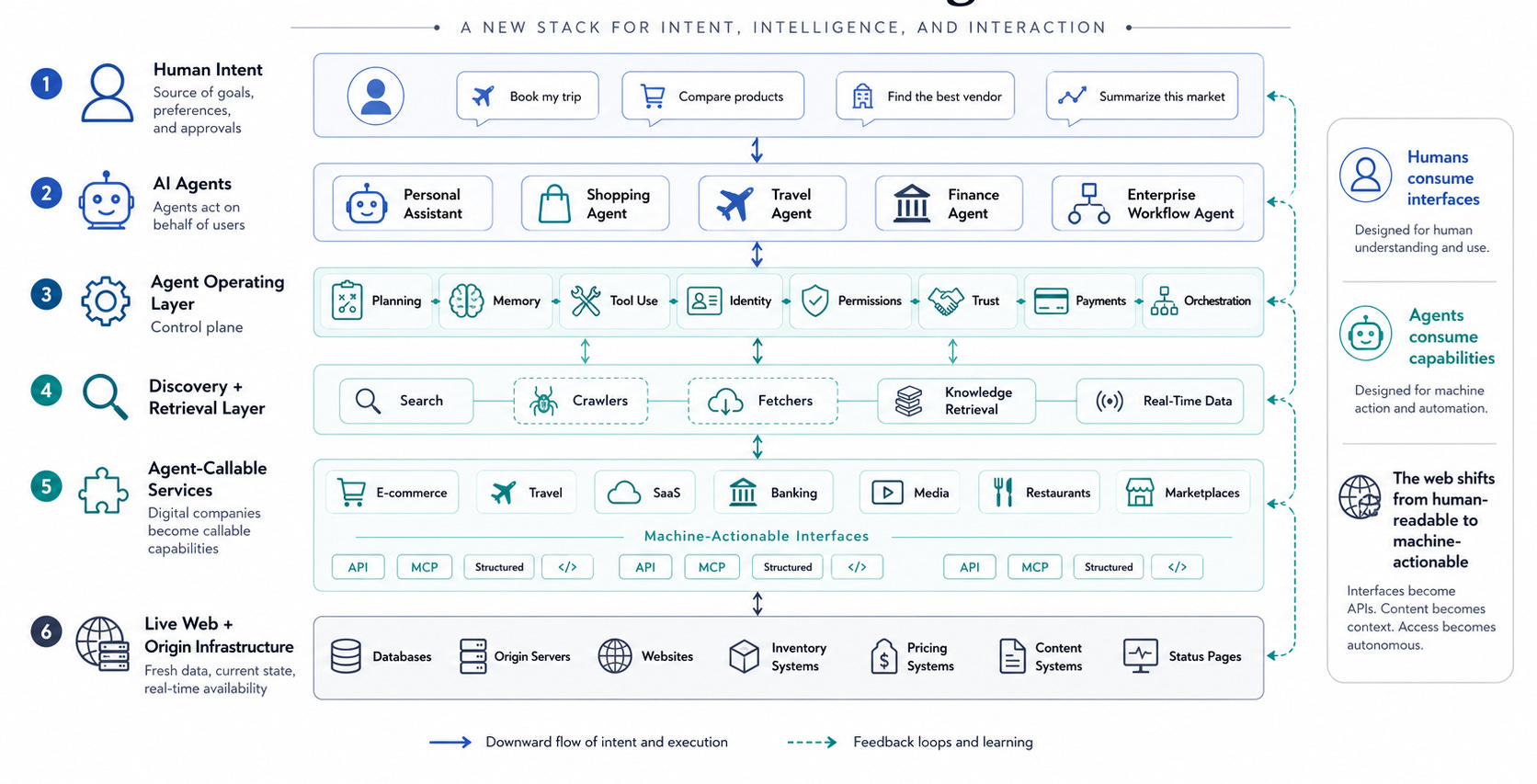
1. Your API is now your front door. If your product can only be accessed through a human-navigable interface buttons, menus, visual flows, you are increasingly invisible to the agent layer. Agents want structured data, APIs, and clear semantic signals. The companies winning in the agentic era are building machine-readable interfaces alongside human-readable ones, if not instead of them.
2. SEO is being replaced by AEO: Agent Engine Optimization. The question is no longer “does Google rank us?” It is “do AI agents recommend us, cite us, transact with us?” Being cited as a trusted source by large language models is the new organic traffic. This requires high-authority content, structured data, and presence in the datasets that AI systems train and query from. Some are calling this Generative Engine Optimization (GEO) a discipline that barely existed two years ago and may be the most important marketing function within five.
3. Revenue models must evolve beyond attention. If your business model depends on human eyeballs viewing advertisements, you are building on a foundation that is actively eroding. The companies positioned for the agentic future are those moving toward usage-based pricing, API access fees, agent-specific subscription tiers, and micropayment architectures. Platforms must begin treating AI agents as paying customers entities with their own authentication, permissions, and economic relationships.
4. Trust and verification become critical infrastructure. HUMAN Security’s report identified the defining challenge of the new era: it is no longer enough to detect whether traffic is automated. The question is whether a given agent is legitimate. Malicious and benign automation are now separated by less than half a percentage point in behavioral profiles. This has created an entire new category of infrastructure “AgenticTrust” designed to verify the identity and intent of AI agents at the session level, in real time.
5. Human experience is now a premium differentiator. Ironically, as AI Agents become the default users of digital services, genuine human experience human curation, human creativity, human judgment, human connection becomes rarer and more valuable. The brands that will command loyalty in the agentic era are not those with the most efficient automation, but those that know precisely when to bring the human back.
The deeper question
There is a question beneath all of this that the traffic data alone cannot answer, but that every founder, every executive, and every person building something for the internet must eventually confront:
If AI agents are our users, who are we actually building for?
The honest answer, perhaps, is both. We build AI-friendly infrastructure because that is where the traffic lives. We build human-centered experience because that is where the meaning lives. The former without the latter produces efficiency without purpose. The latter without the former produces purpose without reach.
The internet’s majority users are now AI agents. That is the data. But the machines are running errands for humans researching, booking, comparing, managing so that humans can spend less time on the mechanical parts of living and (theoretically) more time on the parts that matter.
The question is whether we will design the agentic internet intentionally, or simply let it happen to us while we stare at dashboards watching our human traffic decline.
The crossover has already occurred. The only thing left to decide is what we do with that fact.
The beginning of the World Wide Agents
The first web connected documents.
The second web connected people.
The third web connected applications.
The next web connects agents.
A World Wide Agents layer.
In this world, every company becomes a set of callable capabilities.
Every user has agents acting on their behalf.
Every workflow becomes a chain of autonomous executions.
Every business competes not only for human attention, but for agent trust.
Every digital service must answer a new question:
Can an AI agent understand, access, and execute with us?
If the answer is no, the company becomes invisible to the fastest-growing user class on the internet.
Not because humans disappeared.
But because humans delegated.
That is the true meaning of the machine majority.
The internet is not dead.
It is being reallocated.
Humans still create meaning.
Humans still define goals.
Humans still decide what matters.
But machines increasingly navigate the digital world.
The next billion users of digital companies may not have names, faces, emails, or passwords in the traditional sense.
They will have permissions.
They will have objectives.
They will have wallets.
They will have APIs.
They will act on behalf of humans.
And they will choose which companies survive in the agentic economy.
The real question for every company
The question is no longer:
How do we get more human traffic?
The better question is:
How do we become useful to agents acting for humans?
Because traffic is changing.
Discovery is changing.
Conversion is changing.
Interfaces are changing.
Users are changing.
The first users of the digital world were humans.
Now AI agents are taking first place.
And the companies that understand this early will not just adapt to the future of the internet.
They will build it.
This is the future we are building for at Iris Labx.
We believe every company will need to become agent-callable.
Not just visible on Google.
Not just accessible through a website.
Not just available through an app.
Callable by AI agents.
That means a world where an AI agents can discover your business, understand what you offer, compare your capabilities, access the right permissions, and execute real actions with you safely, reliably, and at machine speed.
We are building the infrastructure for that world.
AgentNet is the discovery layer: an index of agent-callable services, tools, APIs, MCP servers, and digital capabilities.
Agentizer helps companies become agent-native: turning existing websites, APIs, workflows, and services into interfaces that AI agents can actually use.
LiM (Large Intention Models) is our family model designed to transform human intent into executable actions across tools and services.
The web is moving from human-readable to agent-actionable.
We are building the infrastructure for the World Wide Agents (wwa.)era.
If you are a digital company, marketplace, SaaS platform, commerce business, travel company, financial service, or enterprise that wants to understand what this shift means for you, we’d love to talk.
Joël, Cofounder, Iris Labx